Advantech's UNO-2484V3 Brings Core Ultra Performance to Fanless Edge Automation
The latest UNO-2000 series update pairs Intel Core Ultra (Series 2) processors with DDR5 memory and extensive industrial I/O — a meaningful upgrade for engineers building machine vision and predictive maintenance at the edge.
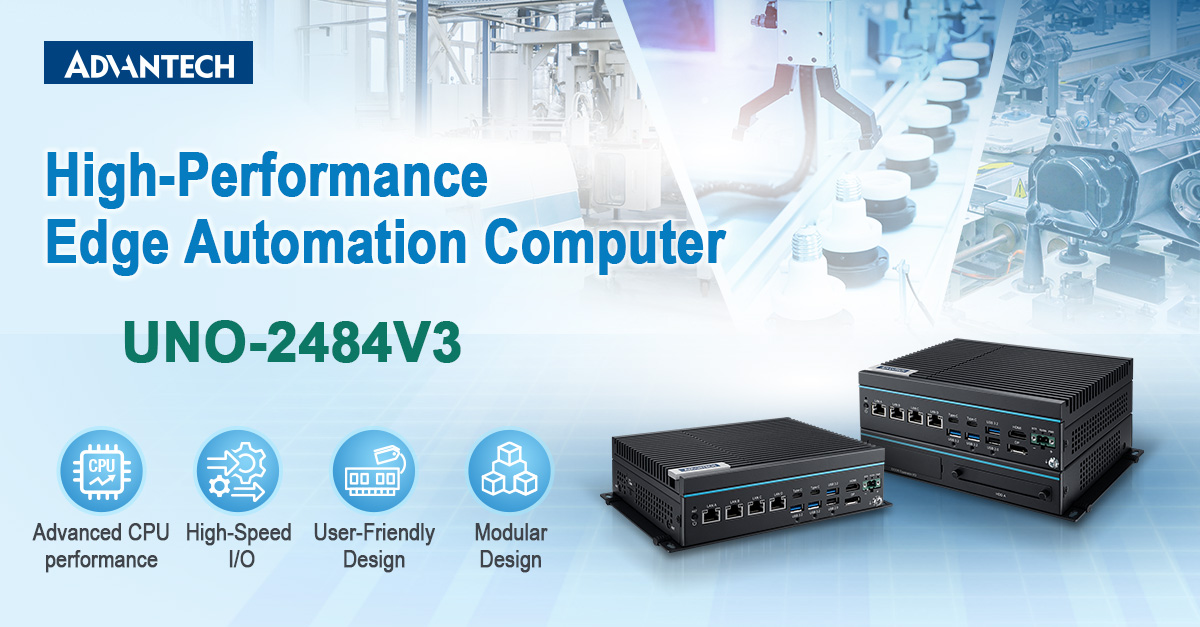
Advantech has launched the UNO-2484V3, a fanless edge automation computer aimed squarely at industrial applications that demand more local compute without sacrificing reliability. The unit replaces 11th Gen Intel Core processors and DDR4 memory used in the previous UNO-2484G V2 with Intel Core Ultra (Series 2) 5 and 7 processors and DDR5-6400 memory — a generational jump that matters for anyone specifying edge platforms today.
Why it matters for engineers and buyers
The procurement case here is straightforward: more cores (up to 14), more cache (12 MB L3), and faster memory translate directly into the ability to run machine vision, predictive maintenance algorithms, and multi-protocol data aggregation locally, rather than shipping everything to the cloud. For plant engineers under pressure to cut latency and network dependency, that's a real operational gain, not just a spec-sheet bump.
Connectivity is equally relevant to procurement decisions. The UNO-2484V3 offers one GbE and three 2.5GbE LAN ports, four configurable RS-232/422/485 serial ports, and support for up to four independent displays — enough to bridge PLCs, legacy serial devices, sensors, and modern HMI/display requirements on a single box. Four M.2 slots and an optional second stack with swappable 2.5-inch SSDs and Advantech iDoor modules give system integrators room to scale storage, wireless, or fieldbus connectivity without redesigning the platform.
Mechanically, the design targets field maintainability as much as raw performance: a removable DIMM cover, externally accessible SIM slot, and interchangeable top cover reduce downtime during upgrades or OEM branding changes. With a 10–36 VDC wide input range, -20°C to 60°C operating window, and a fanless, solid-state 200 × 140 × 55 mm footprint, the unit is built for cabinets and enclosures where dust, vibration, and thermal cycling rule out standard IT hardware. Onboard TPM 2.0 addresses the growing requirement for platform-level security in OT environments.
Nordic relevance
For Nordic manufacturing, maritime, and infrastructure operators pushing toward Industry 4.0 retrofits, this class of device fills a specific gap: enough compute for local analytics and vision inspection, but packaged to survive unheated plant rooms, offshore installations, or remote automation cabinets without active cooling or climate control. The wide-range DC input also suits sites running on battery or generator backup, common in Nordic remote and critical-infrastructure deployments.
As with any edge automation upgrade, the right configuration — memory, storage, expansion modules, OS — depends on the specific application and duty cycle.